Grade 9 Chemistry
Term 1 - 2026
Introduction to Chemistry
Foundations of chemistry: matter, everyday applications, and the main branches of chemistry.
CHEM-G9-INTRO-01 · Introduction to Chemistry12 content · 1 resources
Lesson objectives
- Define chemistry in their own words.
- Define matter and distinguish matter from examples of non-matter.
- State and describe the three main branches of chemistry.
- Identify at least three ways chemistry contributes to everyday life.
What Is Chemistry?
Chemistry is the study of matter and the changes that matter undergoes.
As you work through this lesson, think about the materials and changes you observe around you every day.
Matter and Non-Matter
Matter is anything that has mass and occupies space.
Examples of non-matter given in the lesson are heat, light, sound and energy.
Think: Identify three examples of matter in your surroundings and explain why each qualifies as matter.
Why Study Chemistry?
Chemistry helps us to:
- Explain the natural world.
- Prepare for a career.
- Become informed citizens.
Chemistry in Everyday Life
Chemical reactions are constantly taking place around us. Examples from the lesson include:
- The human body: digestion, muscle movement and other bodily actions involve chemical reactions.
- Photosynthesis: plants convert water, sunlight and carbon dioxide into glucose and oxygen.
- Soaps and detergents: these can be produced by a chemical process called saponification.
- Sunscreen: organic and inorganic compounds can filter or block incoming ultraviolet radiation.
- Cooking: chemical reactions can change the flavour, texture and colour of food.
The Three Main Branches of Chemistry
The lesson identifies three main branches of chemistry:
- Organic chemistry
- Inorganic chemistry
- Physical chemistry
Organic Chemistry
Organic chemistry is the branch of chemistry involving the scientific study of organic compounds. The lesson describes organic compounds as compounds containing carbon atoms bonded to hydrogen.
It deals with the structure and chemical composition of organic compounds, their physical and chemical properties, and the chemical reactions they undergo. Methane is shown as an example.
Inorganic Chemistry
Inorganic chemistry is the branch of chemistry involving the scientific study of inorganic compounds. The lesson describes these as compounds that do not contain carbon-hydrogen bonds.
Examples given are sodium chloride, magnesium oxide and water. Inorganic chemistry studies the behaviour, properties, and physical and chemical characteristics of these compounds.
Physical Chemistry
Physical chemistry is concerned with interactions and transformations when matter undergoes change.
It uses principles of physics to help explain chemical interactions.
Match & Sort: Branches of Chemistry
Research Assignment
In groups of 5–6, research five chemists and outline their contributions to the development of chemistry. Present the findings as a project, booklet or chart.
Suggested rubric from the source: chemists and contributions (10 marks); pictures (2); biographical information (2); creativity and neatness (2); timeliness (2); grammar/mechanics (2). Total: 20 marks.
Review Questions
- Define chemistry.
- Define matter.
- Give one example of matter and one example of non-matter.
- Name the three main branches of chemistry.
- Differentiate between organic and inorganic chemistry.
- Define physical chemistry.
- Give two examples of chemistry in everyday life.
- Classify familiar compounds as organic or inorganic using the ideas in this lesson.
Check Your Understanding
Resources
Atomic Structure
Structure of atoms and calculation of subatomic particles.
CHEM-G9-ATOM-01 · Atomic Structure20 content · 1 resources
Lesson objectives
- State the parts of an atom.
- Differentiate between protons, neutrons and electrons by location, relative mass and charge.
- Calculate protons, neutrons and electrons for given elements.
Starter: Match Elements to Atomic Numbers
Starter Question
What do you call the smallest particle into which an element can be divided while retaining the properties of that element?
Use your answer as a prediction before reading the next section.
What Is an Atom?
An atom is the smallest particle of an element that can exist and still have the properties of that element. It is the basic building block of chemistry and the smallest particle of an element that can take part in a chemical reaction.
Subatomic Particles and Regions of the Atom
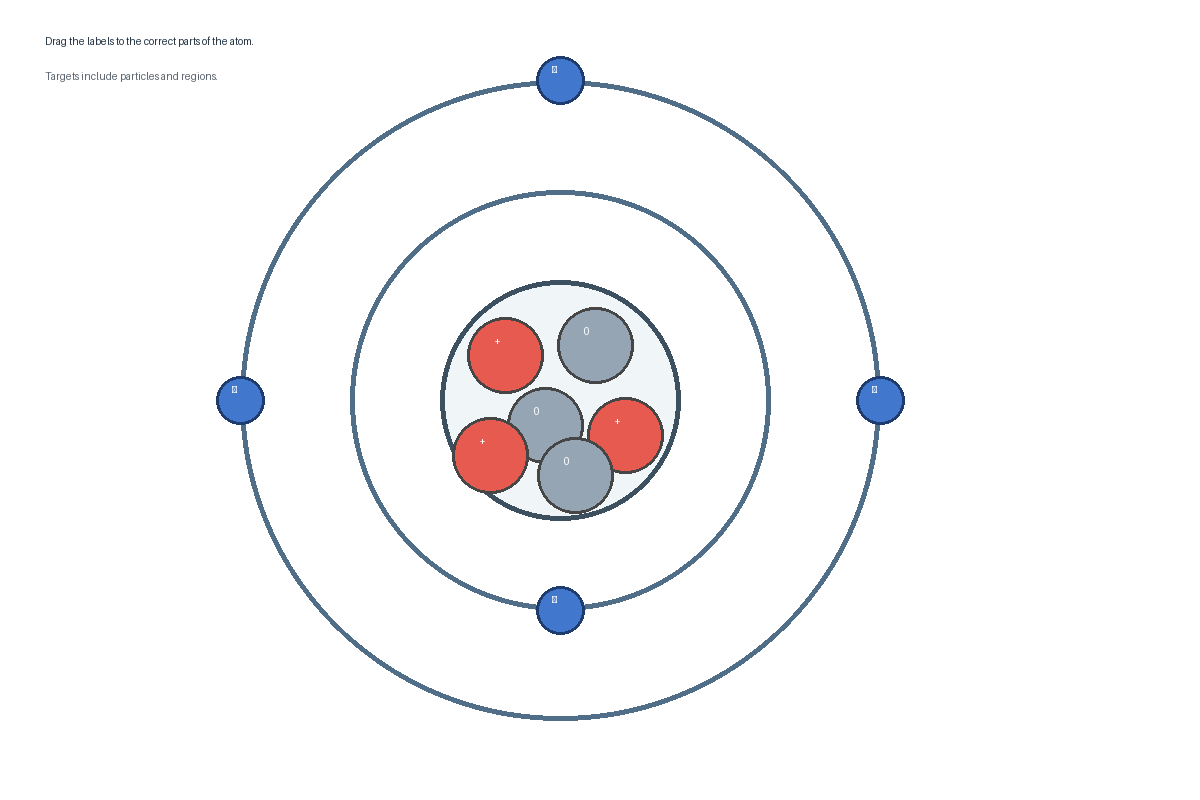
Atoms are made of three fundamental subatomic particles: protons, neutrons and electrons.
The atom has two main regions:
- Nucleus: the centre of the atom; contains protons and neutrons.
- Shells (or orbits in the source lesson): the area surrounding the nucleus where electrons are found.
Match & Sort: Subatomic Particle Properties
Label the Atom
Properties of the Three Subatomic Particles
| Particle | Relative mass | Relative charge | Location |
|---|---|---|---|
| Proton | 1 | +1 | Inside the nucleus |
| Neutron | 1 | 0 | Inside the nucleus |
| Electron | 1/1836 | −1 | Outside the nucleus in shells or orbits |
An atomic mass unit (amu) is approximately the mass of a proton or neutron.
Charge of Atoms
Protons are positively charged and electrons are negatively charged. In a neutral atom, the number of protons equals the number of electrons, so the overall charge is zero.
Example: helium has atomic number 2. A neutral helium atom therefore has 2 protons and 2 electrons.
Chemical Symbols
Each element has a chemical symbol. Symbols are usually one or two letters long. The first letter is capitalized; if there is a second letter, it is lower case.
Examples: H for hydrogen, O for oxygen and Mg for magnesium.
Try it: choose the correctly written symbols for potassium, fluorine and sulphur.
Match & Sort: Correct Chemical Symbols
Atomic Number and Mass Number
Atomic number (Z) is the number of protons in the nucleus. The number of protons determines the identity of the element.
Mass number (A) is the total number of protons and neutrons.
For a neutral atom: electrons = protons = atomic number.
To find neutrons: neutrons = mass number − number of protons.
Atomic Structure Relationship
Remember
A = mass number Z = atomic number (proton number) N = neutron number.
Therefore, N = A − Z.
Worked Examples
Silver
For silver with mass number 108 and 61 neutrons: Z = 108 − 61 = 47. Therefore it has 47 protons.
Aluminium
If Al has 13 protons and 14 neutrons, then a neutral atom has 13 electrons, atomic number 13, and mass number 27.
Sodium
For Na with atomic number 11 and mass number 23: protons = 11, electrons = 11, neutrons = 12.
Magnesium
For neutral Mg with 12 electrons and mass number 24: protons = 12, atomic number = 12, neutrons = 12.
PhET Investigation — Build an Atom
Use PhET's Build an Atom simulation as an exploration before or after the calculation section.
- Spend a few minutes freely building atoms. Record two observations.
- Build a neutral helium atom. Record its protons, neutrons, electrons, charge and mass number.
- Add one proton. What changes: element identity, charge, or mass number?
- Return to a neutral atom and add one electron. What changes?
- Add or remove a neutron. What changes and what stays the same?
- Build sodium with atomic number 11 and mass number 23. Check that your particle counts agree with your calculations.
- Challenge: create two atoms with the same number of protons but different numbers of neutrons. Compare their mass numbers.
This activity needs internet access unless the simulation has been made available locally beforehand. The rest of this course pack remains usable offline.
Match & Sort: What Does Each Quantity Tell You?
Practice Table
Complete the missing values using the relationships in this lesson.
| Element | Protons | Neutrons | Electrons | Mass # | Atomic # |
|---|---|---|---|---|---|
| Calcium | ? | ? | ? | 40 | ? |
| Phosphorus | ? | ? | ? | 31 | ? |
| Silicon | ? | ? | ? | 28 | ? |
| Argon | ? | ? | ? | 40 | ? |
| Neon | ? | ? | ? | 20 | ? |
| Nitrogen | ? | ? | ? | 14 | ? |
| Hydrogen | ? | ? | ? | 1 | ? |
Practice Table — Answer Check
| Element | p | n | e | Mass # | Atomic # |
|---|---|---|---|---|---|
| Calcium | 20 | 20 | 20 | 40 | 20 |
| Phosphorus | 15 | 16 | 15 | 31 | 15 |
| Silicon | 14 | 14 | 14 | 28 | 14 |
| Argon | 18 | 22 | 18 | 40 | 18 |
| Neon | 10 | 10 | 10 | 20 | 10 |
| Nitrogen | 7 | 7 | 7 | 14 | 7 |
| Hydrogen | 1 | 0 | 1 | 1 | 1 |
Atomic Structure — Multiple Choice Check
Final Recap
- Define an atom.
- Name the three subatomic particles.
- State the charge, relative mass and location of each subatomic particle.
- Explain why a neutral atom has an overall charge of zero.
- Explain the difference between atomic number and mass number.
- Use A = Z + N to calculate a missing particle number.